


PaulB
-
Posts
637 -
Joined
-
Last visited
Everything posted by PaulB
-
The rap stations that descend from the Bugaboo-Snowpatch col are set up for single ropes, but having double 60's will let you do the whole thing in two raps using the stations on the Snowpatch side. The Kain Route on Bugaboo is fully equipped for descent with a single rope. Due to the nature of the route, I don't think having doubles would make much difference.
-
Don's Waddington Guide has a great section with tips & tricks for air drops.
-
Yes, you can ride up the 7th Heaven lift and make an easy traverse across the slopes above Lakeside Bowl to reach the base of the Blackcomb Buttress and DOA. Check the Whistler web cam for snow conditions. The Blackcomb Buttress is mostly 3rd class, maybe some 4th. Depending on your comfort level, you could do it without a rope. DOA is supposed to have a more technical pitch, so a small rack might be appropriate. After summitting, a fun option is to traverse all the way along the ridge that heads back towards the top of the 7th Heaven lift. Good exposure on a couple of towers, and "fine situations throughout". Keep an eye on the time, as its a long walk to the village if you miss the last chair down.
-
Is there actually an REI Outlet Store, or is it just a website? I'll be driving through Seattle this week, and thought I might stop to check it out. If there is a store, where is it located?
-
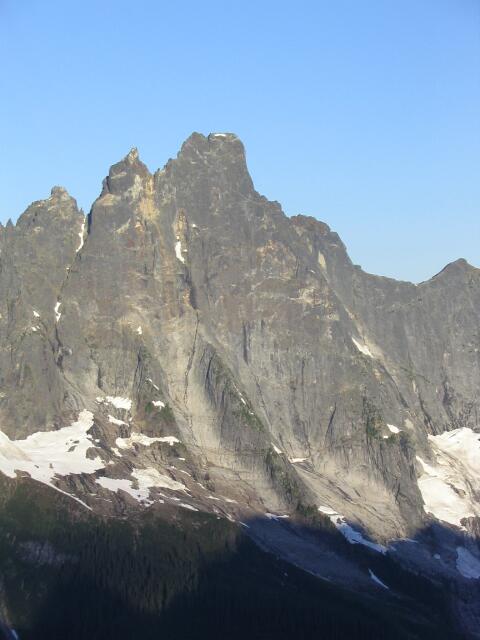
Here's what it looks like a month later (attached photo taken July 18).
-

New Study Shows Rock Climbers Prefer Unvegetated
PaulB replied to Dru's topic in Rock Climbing Forum
Just to provide some background, the crags in question are primarily Rattlesnake Point, Kelso, Mt. Nemo and probably Lion's Head. The first two are mostly top-roping/trad areas, the third is almost exclusively trad with a few bolted lines (unless the top roping & bolting ban has been lifted), and the last is almost entirely sport climbing (in a spectacular setting above Georgian Bay). The reason for studies like this over the years is that the first three crags are about a 40 minute drive from downtown Toronto (Canada's largest city), and during the 80's and 90's saw a huge increase in climber traffic. The cliffs are also home to old growth cedar trees (they look like shrubs, but some are over 500 years old!), which were felt to be in danger from the uncaring climbers and their disruptive ways. Much hullabaloo and gnashing of teeth between climbers and environmentalists has occured over the years, with climber's access being seriously threatened. A ban on top roping and bolting at Mt. Nemo was self imposed in an effort to keep the peace. It's good to see a report that seems to agree with what many climbers have said all along, but I'm sure that there is another report out there that claims the opposite. -
Drive: Hurley & Lillooet River Roads Date of Drive: 7/10-11/2004 Trip Report: Gary Shorthouse and I headed out the Hurley River Road on Saturday with the intention of climbing Mt. Sloan on Sunday. To get full value out of the drive, we checked out the approaches to a few other climbs. Here's what we found: Mt. Samson -------------- The bridge over Donelly Creek has been removed, so you'll have to walk (or ride a bike) from the Hurley to the end of the 4wd-hc section described in Alpine Select. There was a truck parked at the blockade, so someone has made the effort. Mt. Thiassi (East Side) ------------------------- The bridge over the Hurley River has been removed, so you can add a lot more walking to the already lengthy east side approach. Note that the river is quite wide here, and fording it may be tough. Mt. Thiassi (West Side) ------------------------- From the Bridge River FSR, the McParlon Creek road was driveable to about 7km, where it was blocked by large boulders from a rock slide. Other reports indicate that a bridge at 10km has also been removed. Still, this is probably the fastest way to get to Thiassi. Mt. Sloan ----------- There is a new spur from the bridge over Ault Creek which winds up and over the broad toe of the NE Ridge. From the end of the spur, it should be possible to thrash through the forest to get on the crest of the ridge and above treeline. This would avoid the steep climb up from Ault Creek which is the traditional approach for the NE Ridge. From the look of things, they're getting ready to cut down a whole lotta trees. Since it rained most of the night, we bailed on the climb and headed back to Pemberton. We refueled, had breakfast and headed out the Lillooet River Road for more exploring. Overseer Mtn. --------------- The Meager Creek Branch road is gated and locked at the Lillooet River bridge. Again, a long walk (or bike ride) can be added to the normal approach. Mt. Athelstan --------------- As Don reported in his TR for Lillarete & the Randy Stoltman Tower, the access to Athelstan is pretty good. I interpreted the correct path through the confusing array of spur roads as right/left/left/right, but the process of elimination will eventually get you to the end of the correct spur, which now has a small cairn at the end. A short distance into the forest you will see flagging for an extension of the road, and be able to pick up the Salal Creek trail, which also appears to be flagged. Note that this trail does not take you up to the climbs on the Salal Creek wall. Gear Notes: - Chevy 4x4 - $130 worth of gas - Alpine Select Guide Book - NTS Maps - GPS - Backroads mapbook - Assorted CD's Approach Notes: It was all approach!
-
Gender? - Male What system do you use now? Moon, through the crotch, drop seat, nothing (system must be dropped). - Through the crotch for all layers (otherwise it just doesn't work!). How long have you used that system? - 8 years Why do you use that system? - It is warm, versatile and convenient. In a perfect world what system would you use? What I'm using now.
-
Me too, except mine doesn't have the fancy "teeth" on the cams. I've found that a #2 Metolius and a 0.5 tricam are interchangeable most of the time. I use the tricam in low stress situations, and save the Metolius for when I don't want to futz with the tricam.
-
Salomon Pro-Ice Boots, Kayland Revolution,
PaulB replied to COL._Von_Spanker's topic in The Gear Critic
To me, the Pro Ice is closer to the Super Mountain 9 than the Super Mountain Expert. At first glance the Expert looks bulkier and "clunkier", while the Pro Ice looks more streamlined. I'd probably get the Pro Ice to replace my SM 9's, although I suspect that they're stiffer than the Expert. -
Latest from CBC News: Hikers' bodies found in Banff park Last Updated Mon, 05 Jul 2004 21:41:40 BANFF, ALTA. - The bodies of two missing hikers were discovered Monday by wardens in Alberta's Banff National Park. Kevin James and Mike Farrow had been missing since early June. The two men, both in their early 20s, were adventure tourism students at the University College of the Cariboo in Kamloops, British Columbia. They had set out on June 3 to hike up Mount Deltaform near Lake Louise, but were reported overdue. Park officials say it appears bad weather forced the two men to turn back before they reached the summit. The wardens believe they were hit by either rocks or snow on their way down the trail.
-
MEC members can get a discounted subscription now. There was also a note in the CAJ that gave a discount code for a subscription.
-
About a month ago, on the way to Skaha, at a Friday night roadblock near Hope: Cop - "You boys had anything to drink tonight?" Shorthouse - "No." Cop - "What's in that cooler?" Shorthouse - "Beer!" Cop - "Alright, have a good night"
-
I was looking for the same thing last year, and settled on the Garmont Ferratas. They have performed well on easy alpine rock (West Ridge of Pigeon Spire & Blackcomb Buttress) and ice (NW face of Matier). Probably not truely waterproof, and durability is a relative term depending on frequency of use. I expect/hope to get at least 5 years out of them. I think the Ferratas have been discontinued, but the Tower GTX is essentially the same boot. The other contender was the Sportiva Trango Plus, but I prefer leather over synthetics.
-
When I was there last summer, we met a guy from the Basque region who would hike up from the parking lot every day looking for someone to climb with. He was camping with his dog so he couldn't stay at Applebee or the hut. He joined us on Pigeon Spire and it sounded like he had been able to hook up with other groups as well.
-
Not at all.... I subscribe to the same school of thought. As a result, I have seven packs of varying sizes and with various features. It's all about mental health!
-
Got this in an email from Intrawest today. The long rumoured expansion around Flute is finally happening: The big is getting bigger. Whistler Blackcomb introduces 1100 acres of new terrain on Whistler Mountain with the official opening of the long-awaited west side of Whistler, Peak to Creek, and the addition of Flute Bowl, offering a unique in-bounds backcountry experience. The new areas comprise Whistler Mountain's single largest terrain expansion ever.
-
Here is an example of the end result. I never file the teeth on my picks, so I don't know what started the cracking, but it propagated through about 1/3 of the pick (probably over a couple of seasons) before breaking. A classic example of metal fatigue. It failed as I was 20 feet into the steep pitch on Night'N'Gale. Fortunately, I was seconding... unfortunately my spare pick was 300m below me in the truck.
-
These days, just about any set of ice tools will be adequate for someone new to the sport. Find a cheap used pair that will let you get out climbing. Borrow different tools whenever you get the chance, and eventually you'll find a pair that just "feel right". If you're lucky they'll be the pair you bought, but more likely you'll be wanting something else after your first or second season.
-
A couple of my friends once agreed to use three tugs. This proved unwise when one of them was at an awkward crux, trying to clip into a piece he had just placed. With the rope in his teeth, he yarded up for the third time to get enough slack to make the clip, only to hear his partner yell "belay off"! I don't think they used the tug system anymore after that. When climbing with regular partners, you develop a good sense of their movement while climbing and how they handle the rope at belays. While its best to use verbal signals whenever possible (which makes radios a good choice) accumulated experience often tells you what needs to be done.
-
Which features do you use on your altimeter watch?
PaulB replied to Dr_Crash's topic in The Gear Critic
My Timex Ironman (it's about 10 years old) has a great alarm. It's loud and annoying enough to wake me from all but the deepest sleep. -
Which features do you use on your altimeter watch?
PaulB replied to Dr_Crash's topic in The Gear Critic
I have an Altimax and the features I use depends on what I'm doing. In the winter, I use the log book to track my accumulated ascent/descent, number of runs, etc. when ski touring. Hardly ever look at the actual altitude. In the summer when I'm alpine climbing I calibrate the altitude as often as is practical, so that it's accurate if/when I need it, but I hardly ever use the logbook. When I'm camping at a fixed location for more than one night, I use the barometer to track weather changes. I've never used the altitude alarm, and only occasionly make use of the differential altitude or pressure feature. The stopwatch is nice to have but hardly ever gets used... same for the countdown timer. The alarm clock is useful, but the alarm is too quiet. I usually have to set all three alarms 1 minute apart to make sure I hear them. -
Cinder Cone history lesson here.
-
The A80 came out about a month after I bought my A70, I suspect they're pretty similar. I went with the A70 because it had good reviews for picture quality, has lots of manual adjustments and it uses AA batteries. The AA's make it bulkier, but I can use them as backups for my GPS, avi beacon and headlamp. My only complaint with the A70 so far is that it doesn't deal well with high contrast scenes like a lone skier/climber on a snowfield. More experimentation with the manual controls would probably help minimize this.
-
The truth comes out! He told me he turned around because it was too hot.... no mention of a forgotten water bottle. You have to keep an eye on those donkeys!