

aikidjoe
-
Posts
93 -
Joined
-
Last visited
-
Days Won
3
aikidjoe's Achievements






-
My 2 cents, in general, July is now late for Liberty Ridge because, as you say, melting is far worse. Tons of rockfall and ice fall hazard, really just luck if you don't get hit by something. Memorial Day weekend (when the road to White River usually opens) through mid June are better options, but less reliable weather so have to be flexible. When I did it around Memorial Day weekend in 2015 we were nearly killed by a serac fall near the top of the route, and there was a ton of rock debris around thumb rock (fortunately none fell on us while sleeping). That was a low snow year, but my observation is Tahoma has only gotten rockier and less icy since then.
-
Mount Baker Snoqualmie Forest thinning project - public comment
aikidjoe replied to aikidjoe's topic in Climber's Board
It's probably easiest to just paste what my public comment was, so see below. Maybe (hopefully) I'm overreacting? But I think what takes me aback is the apparent scale of the operation, lack of clarity of what areas are being impacted exactly, lack of clarity that this will actually work (is this an experiment on a huge scale? Or is there evidence that this restores long term forest health? Is this even about long term forest health?). Happy to hear your perspective on this. Thank you for the opportunity for commenting on this project. While I am no expert in forestry and forest management, I am a deeply concerned citizen who cherishes our forests and the MBS in particular. I know enough to understand the theoretical need to thin our young forests that were devastated by clear cutting and then overplanted. I have also always thought of forest thinning as a potentially good sustainable option for forestry, and I know there are examples of such forestry around the world. That said, there are many reasons that this project causes concern for me, and why, despite the above, I can't support this project with the information provided in the EAS. 1. The proposal appears to be for "the entirety" of the MBS forest land that meet certain criteria then goes on to say that the intensity of thinning will depend on the location, but no information on specifics is given. What parts of MBS are more intensely thinned? What parts less? What portions of MBS meet this criteria? Will portions bordering designated Wilderness Areas received less intensive treatment as a buffer zone? 2. The proposal seems to suggest that this will thin the forests to 35% coverage. What is the basis for this percentage? Is it scientifically validated as something that will increase the health of the forest? Or is it what is economically viable for the logging companies to make profits while having to practice the more labor intensive thinning vs. clear cutting? 3. One reason for thinning is to reduce potential for wildfire intensity and spread long term. The EAS seems to suggest the the risk for wildfire in thinned areas would increase after thinning due to the dead debris left behind. This seems counterproductive. Shouldn't the logging companies be required to clean up the sites appropriately? 4. The EAS says there will be temporary new roads for logging. How many? What density? Furthermore, from my perspective, the word temporary is misleading: roads cleared for logging are temporary on the scale of decades. The EAS seemed to allude to methods to replant logging roads to aesthetically beautify and hide them. Will this be required of the logging companies immediately after they conclude their work? 5. What evidence is there that this method of thinning, including laying down "temporary" roads, will actually help long term forest health? What evidence that human intervention on this scale can produce healthier forests long term compared to nature taking its course? While I'm sure these techniques have been used elsewhere, have the been used on the scale of the entirety of the MBS? This seems to me like an experiment on a vast scale. 6. What is the long term commitment to protecting the forest to ensure this thinning project benefits the regrowth of a healthy robust forest long term so they may return to a mature old growth forest state? Or, given that the EAS states only areas zoned for commercial timber harvest, is this a project to improve the tree health only to be cut down in the relatively near future? 7. What is the plan to ensure wildlife security? While I accept that thinning is preferred to clear cutting for less overall impact, the EAS gives an example image that clearly shows devastation of the understory immediately after the thinning. This proposal then seems to imply they will devastate the entirety of the MBS undergrowth habitat in the qualified zones in the span 30 years. Without understanding what portions of the MBS will be affected and where the affected wildlife will go, how much of land is affected, etc. -
Hey there, I figured I'd post this here in case others hadn't heard about it. I read through the Environmental Assessment Statement and had serious concerns. https://www.fs.usda.gov/r06/mbs/newsroom/releases/forest-service-releases-draft-environmental-assessment-forestwide
-
Thank you for your efforts!
-
best of cc.com [TR] Cascade Volcanoes - Bike-athon 06/06/2025
aikidjoe replied to traildirt's topic in Mount Rainier NP
This is a really cool idea, thanks for sharing! And nice job! -
What a beautiful place, thanks for sharing. Was it very buggy? I've heard horror stories of Alaska mosquitoes but you don't mention it or have bug nets...
-
Amazing!
-
It was a great trip! Thanks Jon for bringing me along! That's pretty shocking the difference in the snow from O-H col from last year. Jon and I had some theories as to why... but I would love to hear other people's thoughts.
-
Hey all - I'm planning a trip in NCNP and have to pick up permits in person for cross country zone. Debating whether it's ok to get there a bit early before the station opens (around 630?) the day of, or if I should go out the day before. We want to be hiking by 10 or earlier. It's been a while since I've had to get permits in person, and I've heard horror stories of wait times, though maybe some of that is alleviated with the online system? I'll be picking it up mid week next week, right before July 4 weekend... Any recent experience and recommendation is helpful. thanks!
-
Re: Triple Couloirs, I've climbed it in fat ice and bony conditions, and the experience is completely different. In fat ice it's pure joy like described above, but when bony it was scary and sketchy as hell, to me anyways, and felt very hard to find gear. I kinda suck at climbing though, so maybe it's just me. It's really hard to catch TC or any of the Dragontail north face climbs in fat conditions I've found sadly. Probably goes without saying, but just throwing it out there because I feel like TC and other Dragontail north face climbs are really fickle to find in prime condition.
-
so cool! congrats!
-
I wonder if social media and outdoor company marketing has simply "commodified" the outdoors. A lot of people seem to be attracted to it for superficial reasons and don't even understand what a wilderness experience is, or what the customs and etiquette are. I guess what I'm saying is they don't even know they're not being considerate; it's just how social media and marketing has projected as the "correct" way to interact with nature now. Not sure that makes sense, as I'm still not sure how best to articulate my thought, but I do sense that social media and marketing is fundamentally changing not just how many people want to go "experience" nature but also the behaviors. It doesn't occur to them they are ruining it for others because social media and marketing has normalized the behaviors we're all lamenting. Just a theory. It's a troubling and sad trend
-
Amazing!
-
Reconnaissance on Dragontail Triple Couloir for May 2023 Climb
aikidjoe replied to Anton Koveza's topic in Climber's Board
My partner and I watched you and other team for a while from the lake, having decided it was much too spicy for our taste. Nice work! -
UW Climbing wall, Oct. 1976 Sunset Magazine
aikidjoe replied to bargainhunter's topic in Climber's Board
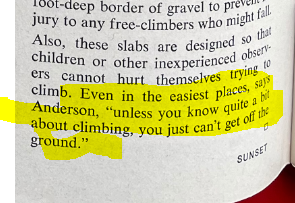
I love this part: I remember in high school during the summer I'd bike to the rock after rowing practice and being so frustrated how I could barely get off the ground! I still feel that way on most of that damn wall....